
A full-grain leather wallet lasts ten to twenty years of daily use, and often much longer. This longevity comes from the material itself: the grain, the densest layer of the hide, is left intact, and the dye penetrates deep into the leather rather than resting on its surface. With a few simple gestures, such a wallet crosses the decades. And it does more than last: year after year, it develops a patina that nothing else can replicate.
One morning, the telephone rang. A customer was hoping to find a model she had bought from us. That was forty years earlier. Forty years. That call says more than any technical sheet about what longevity means for a full-grain leather object.
Why does full-grain leather last so long?
Because the grain is the strongest part of the hide. It is the upper layer of the skin, where the fibres are tightest. Full-grain leather is leather on which this layer has been neither sanded nor corrected: it keeps all the density nature gave it.
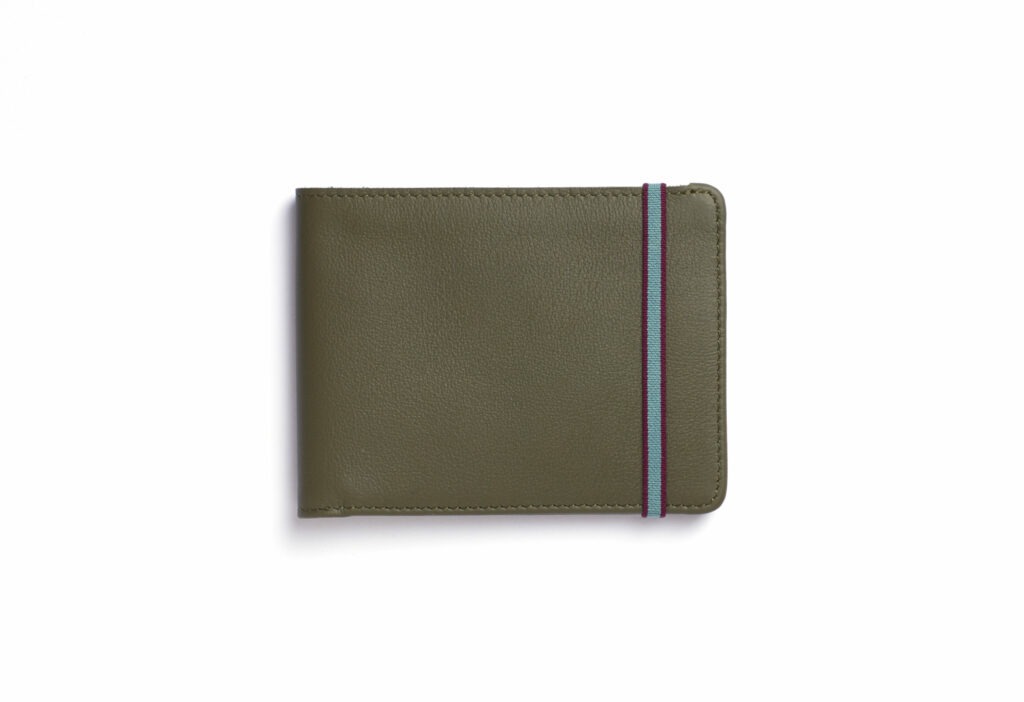
At Carré Royal, we work with full-grain taurillon, a calf leather prized in French leather craftsmanship for its fine natural grain and its strength. We select each hide one by one, checking its grain, its touch, its density. That tight fibre stands up to daily life: the friction of a pocket, the repeated gestures, the cards drawn and returned thousands of times a year. Deep dyeing does the rest: the colour lives within the fibre of the leather itself.
To learn how to tell fine leather at a glance, we invite you to read How to Recognise Fine Leather: The Connoisseur’s Eye.
Ten years, twenty years: what happens to the leather over that time?
It changes, and this is its finest quality. Full-grain leather develops a patina: edges soften, colour deepens, and a gentle sheen appears where the hand rests. A wallet carried for ten years is not a worn wallet. It is an object made unique, shaped by the gestures of the person who carries it.
We have devoted a full page to this: Leather Patina: What It Is, and How It Develops.
What is the real cost of a wallet that lasts?
The question of price changes when you measure it against time. A wallet leaves the pocket several times a day, thousands of times a year. Carried for fifteen years, a 120 dollar wallet comes to eight dollars per year of use, for an object touched every day, one that grows more beautiful instead of wearing out.
This is the difference between a passing object and an object that settles into a life. One is useful for a while; the other becomes a companion, and is sometimes handed on.
What does construction change about longevity?
The material is not everything: a wallet also lasts by the way it is built. Three points carry most of the weight.
The stitching, first. A regular, tight stitch with properly finished ends holds for decades. It is what keeps the wallet’s structure when the leather itself softens with the years.
The edges, next. They are the ridges of the wallet, the areas most solicited each time it slides into a pocket. An edge dyed and burnished with care protects the cut of the leather and ages gracefully; it can also be revived by a craftsman many years later.
The assembly, finally. A wallet designed for real use, with card slots cut to the right tension, does not lose its shape: each card finds its place without straining the leather. At Carré Royal, every piece is finished by hand, precisely because these details only reveal themselves with time. It is at the ten-year mark that careful assembly shows.
Full-grain, corrected grain: why the difference appears with the years
Two wallets can look alike in a shop window. Time is what tells them apart.
Corrected-grain leather (often labelled “top grain”) has been sanded to even out its surface, then covered with a finish that gives it a uniform appearance. It is a widespread manufacturing choice, and it produces neat, consistent objects on day one. But the life of the object plays out in that surface layer: when the finish wears, it does not regenerate.
Full-grain leather takes the opposite path. Its surface is the hide itself, alive, with its natural grain. Use does not deplete it: it polishes it, feeds it, deepens it. Where a surface finish fades, a natural grain develops a patina. That is the whole difference between an object that looks its best at the start and an object that gains from living.
It is this journey through time that guides our choice of hides, one by one.
How do you make a leather wallet last longer?
Very little is needed, and that is one of the reasons to love this material. Keep it away from prolonged direct sunlight. If it gets caught in the rain, let it dry flat at room temperature. Once or twice a year, feed the leather with a suitable cream, in circular motions. And resist overfilling: a wallet keeps its line when it carries the essentials.
The full routine is in our guide Caring for a Full-Grain Leather Wallet: Patina, Care, Longevity.
When does a wallet truly reach the end of its life?
Much later than you might imagine. Stitching can be redone, edges can be revived. Full-grain leather softened by the years is still fine leather. The moment to change usually comes from a change in habits: fewer coins, more cards, the appeal of a slimmer format. Our page on wallet formats accompanies that reflection.
And a wallet that has lived often finds a second life: kept in a drawer with its memories, or passed on, patina included, to someone who will write its next chapter.
FAQ
How many years does a full-grain leather wallet last?
Ten to twenty years of daily use, and often longer with simple care. Some of our customers have carried the same wallet for several decades.
Does full-grain leather wear out with daily use?
It evolves more than it wears: the grain polishes, the colour deepens, a patina forms. The density of its fibre protects it from everyday friction.
Is a full-grain leather wallet worth it?
Measured against time, yes. A wallet carried for fifteen years comes to a few dollars per year of use, for an object used every day that becomes more beautiful with age.
Can a well-used leather wallet be repaired?
Most often, yes. Stitching can be redone and edges revived by a craftsman. That is one of the privileges of well-made objects.
Does the colour hold over time?
Yes. Our leathers are dyed in depth: the colour lives within the fibre of the leather. It deepens with the years instead of fading.
What is the difference between full-grain and top grain leather?
Full-grain leather keeps the natural surface of the hide intact, with all its density; top grain has been sanded and covered with a finish. Both look neat on day one; with the years, a natural grain develops a patina while a surface finish gradually wears.