
Two wallets can look alike in a shop window and meet opposite fates: one flakes and fades within two years; the other softens, deepens and grows more beautiful for twenty. The difference was there from the first day,visible, touchable,for whoever knew where to look. This guide teaches exactly that: the five ways a connoisseur reads a piece of leather before buying it.
The trap of “genuine leather”
Begin with the phrase that misleads more buyers than any other. On a label, “genuine leather” is not a compliment,it is a grade, and a low one. The industry ranks leather by how much of the hide’s natural surface survives the process. At the top: full-grain leather, where the outer surface (the grain) is kept intact, with its pores, its density, its natural resistance. Below it: “top grain”, sanded to erase imperfections. Below that: “genuine leather”, made from lower layers of the hide, often coated with an artificial finish to imitate a grain it no longer has. At the bottom: bonded leather,scraps glued together, leather in name only.
Why does this matter so much? Because everything a fine leather does,the durability, the patina, the way it improves instead of degrading,lives in the grain. Sand it away and you have removed the very thing you were paying for. When the label says only “genuine leather”, it is telling you, discreetly, what the leather is not. Everything Carré Royal makes is taurillon (bull calf) full-grain leather,the phrase to look for, on our objects or anyone else’s, is full grain.
Where the confusion comes from
The vagueness is not accidental. For most of history, “leather” needed no adjective: hides were tanned whole and the surface was the surface. The twentieth century industrialised the material,splitting hides into layers, sanding, coating, embossing artificial grains,and the vocabulary blurred along with the product. “Genuine leather” became legally true (it does come from a hide) and commercially misleading (it names the lowest usable layer). The connoisseur’s response is not cynicism; it is a sharper eye. The five checks below take less than a minute, and no coating survives all five.
The four checks
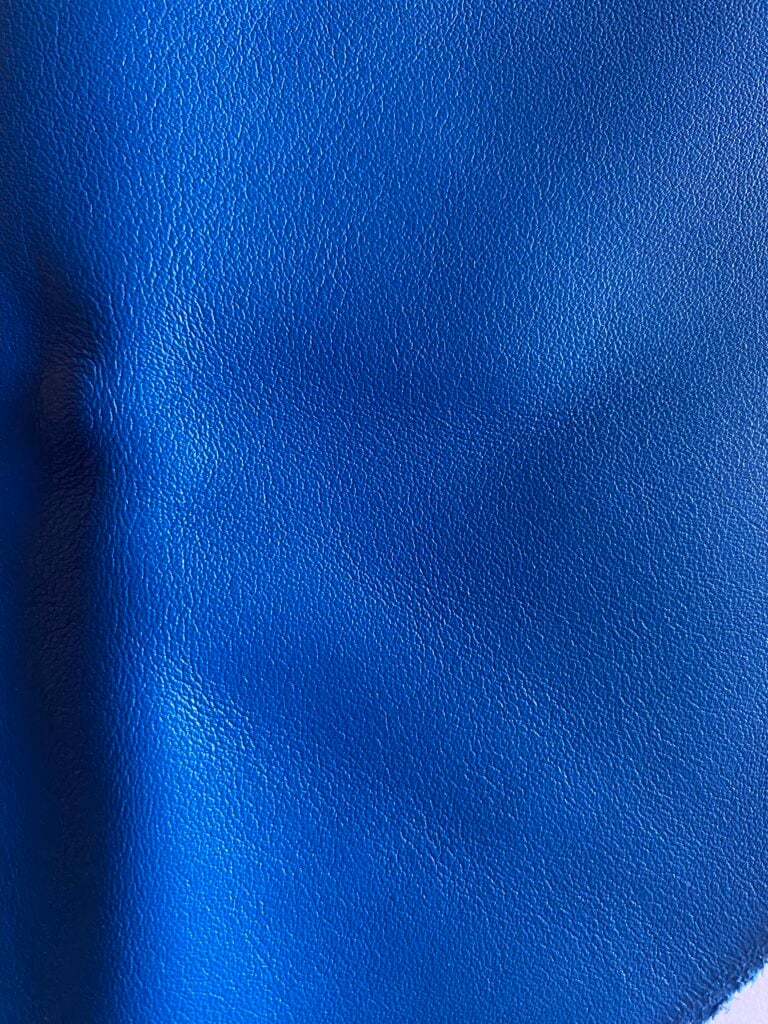
1. Read the grain. Look closely at the surface. Real full grain shows a fine, slightly irregular texture,pores, subtle variations, the record of a life. A surface that is perfectly uniform, with a repeating pattern, has been embossed: a stamp imitating nature, and doing it too well. Nature does not repeat.
2. Look at the edge. The cut edge of a wallet tells the truth the surface can hide. A fine object shows a dense, smooth edge, finished and often painted or burnished in successive layers,slow, careful work. A fibrous edge, or one hidden under a thick plastic-like bead of coating, betrays economy where it shows least and matters most.
3. Examine the stitching. Regular, tight, straight stitching, with no loose threads, at an even distance from the edge,this is the signature of careful making. The stitching is where a maker’s discipline is easiest to verify: whoever stitches well has usually done everything else well.
4. Trust your hand. Fine full-grain leather is supple and warm to the touch, with a slight resistance that yields,it feels alive. Coated leathers feel cold, slick, faintly plastic; the hand knows before the mind does. Press gently: full grain creases finely and recovers; a coating creases like a film.
The question that tests the house: tanning
One more question separates makers who know their material from those who merely sell it: how is the leather tanned? Tanning,the transformation of raw hide into stable leather,takes two great paths.
Vegetable tanning, the method, that uses plant tannins, takes weeks, and yields leathers that patinate magnificently.
Mineral tanning, the method, is faster and yields supple, consistent, richly dyeable leathers,the path of most fine coloured leathers, including the luminous shades of The Color Edit, our colour palette. Neither is “better”; they serve different purposes, and many fine leathers today combine both. The point of asking is not the answer itself,it is whether the seller has one. A house that cannot tell you how its leather is tanned is telling you something else.
Within Carré Royal we use both types of leathers. Our leathers only come from the European Union, which is a very strong guarantee.
Portrait of a wallet at year five
Here is the final test, though it takes patience: time. At year five, a full-grain leather wallet has deepened in colour, softened into its owner’s gestures, taken a gentle sheen where the hand lives; its edges have rounded with dignity, its stitching still holds its line. At year five, a “genuine leather” wallet has cracked at the folds, flaked at the corners, and revealed the grey fibre under its printed skin. One object has aged; the other has expired. Everything in this guide exists to help you tell them apart at year zero,when it is still a choice.
FAQ,Recognising fine leather
Is “genuine leather” good quality?
No,it is a grade, and a low one. “Genuine leather” names lower layers of the hide, usually coated to imitate a natural surface. The phrase that signals quality is “full-grain leather”: the intact outer surface of the hide, the most durable grade and the only one that develops a true patina.
What is the difference between full-grain and top-grain leather?
Full grain keeps the hide’s natural surface intact, with its pores and density. Top grain has been sanded to remove imperfections,more uniform, but weaker and unable to patinate properly. Full grain is the higher grade.
How can I tell real full-grain leather in a shop?
Five checks: a fine, slightly irregular grain (never a repeating pattern); a dense, well-finished edge; regular, tight stitching; a warm, supple feel that creases finely and recovers; and a natural leather scent. No imitation passes all five.
What is taurillon leather?
Taurillon is French for bull calf,a leather prized for its pronounced, lively grain and its density, used by the finest French leather houses. All Carré Royal pieces are made of full-grain taurillon leather.
Is vegetable-tanned leather better than mineral-tanned?
Neither is better in absolute terms. Vegetable tanning, the historic method, gives leathers that patinate deeply; mineral tanning gives supple, consistent leathers that carry rich colour,the path of most fine coloured leathers. The revealing question in a shop is whether the seller knows how their leather is tanned at all.
Why does fine leather cost more?
Because full-grain hides are rarer (only the best hides can be used unsanded), and because the finishing,edges, stitching, assembly,is slow work. The economics reverse over time: a fine wallet lasts decades where cheap leather lasts two or three years.
