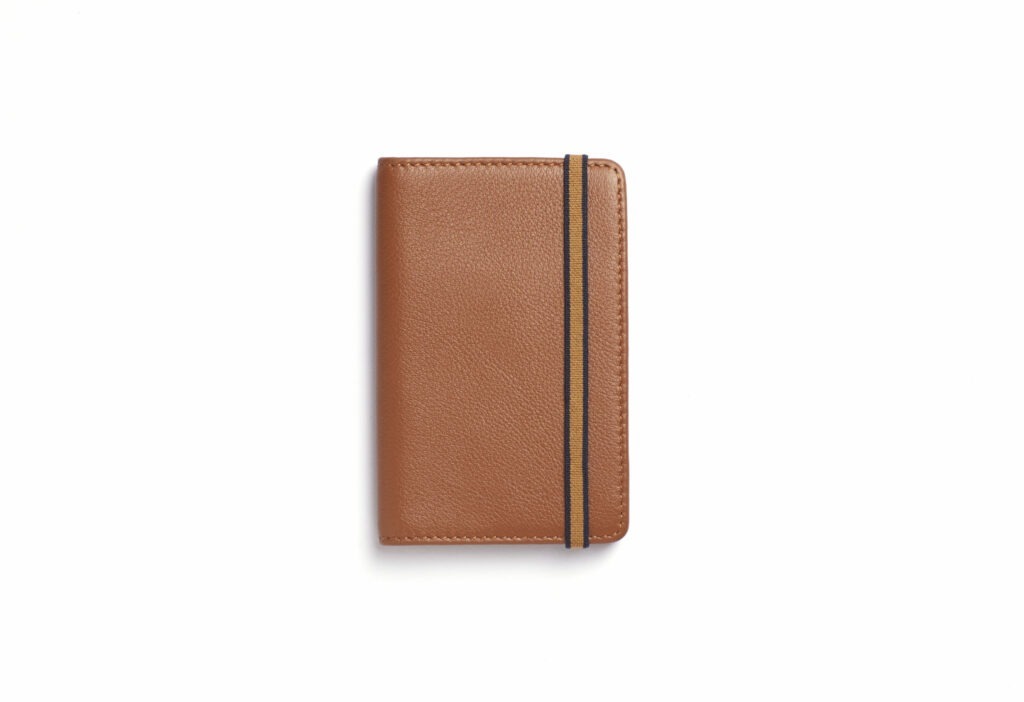
There is a question we are often asked, with a hint of concern: “My wallet is changing colour — is that normal?” The answer holds in a single word, and it is one of the most beautiful words in the vocabulary of leather goods: patina. Not only is it normal — it is precisely what one hopes for from a quality leather. This piece explains what patina is, how it forms, why it distinguishes great leathers from the rest — and why, at Carré Royal, we consider it the signature of time upon a well-made object.
What Is Patina?
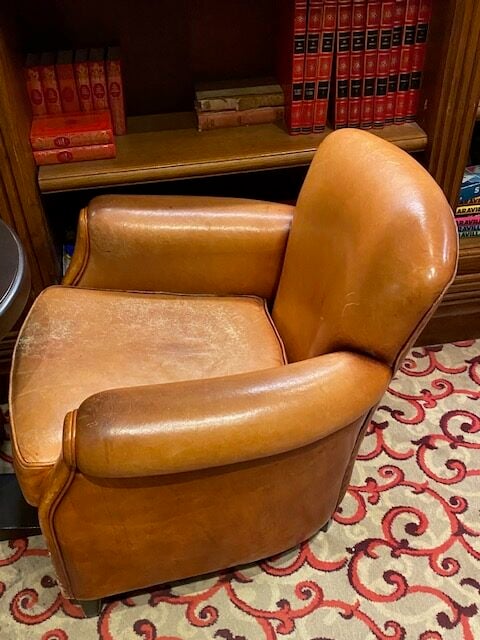
The word comes from the ancient arts: patina first described the blue-green veil that forms on bronze exposed to the elements — the layer that centuries deposit on statues, and that collectors are careful never to remove, because it is both the proof and the beauty of age. Applied to leather, the term describes all the transformations the material undergoes through use: the deepening of the shade, the appearance of a soft lustre at the points of contact, the suppling of the hand, the nuances that emerge between exposed and protected areas.
Patina is neither dirt, nor wear, nor a flaw. It is the exact opposite: the visible proof that a living material responds to time instead of merely enduring it. A wallet with patina is not an aged wallet — it is an accomplished one.
How Does Patina Develop?
Three forces work on leather, slowly and together.
Light, first. Like the wood of an antique piece of furniture, leather responds to ultraviolet rays: its tannins oxidise and the shade deepens — a cognac ambers toward honey, a yellow gains golden highlights, a navy blue takes on an almost nocturnal gravity. This evolution is gradual and even when it comes from daily life; it is brutal exposure (a car’s rear shelf in summer) that produces uneven fading — the difference between a tan and a sunburn.
Contact, next. Every gesture — opening the wallet, sliding it into a pocket, holding it in the hand — imperceptibly polishes the grain. The skin’s natural oils nourish the surface; friction burnishes it. This is how those satin-like areas appear at the corners and along the edges, wherever the hand always returns: a map of its owner’s daily life, written into the material.
Time, finally, which orchestrates the first two. Patina cannot be obtained in weeks, nor by artifice: the first signs appear after a few months, true character after a few years. It is a slowness that cannot be faked — and that is why it has value.
Why Not All Leathers Develop a Patina ?
Here is the point that separates quality leather goods from the rest: patina is a privilege of full-grain leather.
Full-grain leather preserves the upper layer of the hide intact, with its original grain, its pores, its capacity to absorb. It is a living surface: it receives light and oils, it responds, it evolves. Corrected leathers — sanded down and then covered with a pigmented, often plasticised finish — have lost that capacity: their surface is sealed. They do not develop a patina; they wear out. The finishing film scratches, whitens at the corners, and eventually peels. Where full-grain tells a story, corrected leather simply deteriorates.
This is why patina is also a buying criterion: to ask “will this leather develop a patina?” is to ask “is this leather of quality?”. A salesperson who promises that a leather “will stay exactly as it was on day one” is describing, without saying so, a frozen material — that is to say, a dead one.
The Beauty of What Changes: An Idea Larger Than Leather
This value placed on the marks of time is not unique to leather goods. The Japanese made an entire aesthetic of it, wabi-sabi: the beauty of the imperfect, the impermanent, of what time accomplishes. Lovers of raw denim cherish the fades that only wear can draw; musicians, the crackled varnish of an old violin; readers, the suppleness of a book often opened. Everywhere, the same intuition: objects that carry the traces of a life are worth more than objects that carry none.
Full-grain leather belongs to this family of objects. In a world of screens that never age and products designed to be replaced, a wallet that grows more beautiful over ten years is almost a philosophical position — the one William Morris had already summed up: have nothing that you do not know to be useful, or believe to be beautiful. Patina unites the two.
Patina at Carré Royal: Every Colour Has Its Own
On our full-grain taurillon leathers, every shade of The Color Edit writes its own patina. Cognac offers the most spectacular — a continuous ambering toward honey that makes every year a new tone. Yellow turns golden. Navy blue gains a deep, almost solemn lustre. Burgundy deepens toward garnet. Black, the most discreet, polishes to a soft sheen at the points of contact — the connoisseur’s patina, invisible to everyone else.
This evolution holds for all our pieces: wallets, card holders, wallets with coin pocket — and soon our mini bags, whose more generous surfaces will give patina its finest field of expression.
After a few years, two wallets that left the same workshop on the same day no longer resemble each other: each has become a portrait of its owner. That, in the end, is what one offers with a full-grain leather object — not a finished product, but an object that begins.
Accompanying the Patina (Without Forcing It)
Patina asks only one thing: to be allowed to come. Two gestures accompany it — a sober cleaning with a soft cloth, and a colourless leather cream once or twice a year — and two mistakes compromise it: an excess of products, which saturates the grain, and the attempt to even out its nuances, which erases precisely what time has written. Every gesture is detailed in our leather care guide
FAQ — Leather Patina
What is leather patina, in one sentence?
It is the natural, sought-after evolution of full-grain leather through use: the shade deepens, a soft lustre appears at the points of contact, and the piece becomes unique. It is neither dirt nor wear — it is the signature of time on a living material.
How long does it take for a patina to appear?
The first signs — a slight sheen at the corners, a warming of the shade — appear after a few months of daily use. True character reveals itself after two to three years. Patina cannot be artificially accelerated: its slowness is the condition of its beauty.
Do all leathers develop a patina?
No. Only full-grain leather, whose natural surface is preserved intact, develops a patina. Corrected or plastic-coated leathers wear out instead: they scratch, whiten, and peel. The capacity to develop a patina is a criterion of quality.
Patina or wear: how can you tell the difference?
Patina enriches — an even lustre, a deepened shade, a suppler material. Wear degrades — a peeling surface, uneven fading, failing stitches. On a well-cared-for full-grain leather, time produces the former; on a mediocre leather, the latter.
Can you prevent leather from developing a patina?
You can slow it down by limiting exposure to light, but preventing it entirely would deprive the leather of what gives it its value. At Carré Royal, we design our pieces so that patina is an embellishment — one of the reasons behind our choices of tanning and shades.
Does patina develop the same way on every colour?
No — and that is a pleasure in itself: cognac ambers toward honey, yellow turns golden, navy blue gains a deep lustre, black polishes discreetly. Every shade of the Carré Royal palette writes its own patina — detailed in each of our colour articles.