
There are colours one chooses with caution, and colours that impose themselves without hesitation. Red belongs unmistakably to the second category. No other shade summons as many extremes at once, the sacred and the profane, passion and danger, authority and rebellion. At Carré Royal, every colour in the palette reveals a texture, a sensuality that can only be approached through contact with full-grain leather. This piece explores red: its history, its presence in art and interior design, its encounter with taurillon leather, and what it truly means to wear it every day, in a wallet as much as in a mini bag.
A Colour Born With Humanity
Red is not simply one colour among others: it is the first one mankind ever learned to make, wear, and paint, long before it knew how to write its own name. The red ochres found in the caves of Lascaux and Chauvet predate any other known pictorial practice by several millennia, red was therefore never an aesthetic option among many, but an original, almost biological language between man and his environment.
In Ancient Egypt, red held an ambivalent yet powerful place: it designated both the hostile desert (the “red land,” Deshret) and, in certain ritual contexts, vital force and victory over chaos. This founding duality, the red of danger and the red of vitality, would never truly leave the colour again, whatever civilisation took hold of it.
In Ancient Rome, red became a matter of tangible power. The triumphant general, during his parade, had his face painted red, in tribute, it is believed, to the statue of Jupiter itself, coloured with this same shade during ceremonies. Red was therefore not merely seen: it was embodied, worn on the skin of the victor, as an extension of the divine onto man.
In the Middle Ages, the most precious red dye, cochineal, then kermes, cost a fortune, and its use was reserved for the powerful: princes, cardinals, great merchants. To own red was to display a rank few could claim. This material rarity long sustained, in the collective imagination, the association between red and exception — a colour never worn by chance.
In China, unlike in the West where red often borders on danger or prohibition, the colour has been associated since antiquity with luck, joy, and prosperity. It appears at weddings, at the Lunar New Year, on the doors of temples, a red that protects rather than alarms, that invites rather than repels. This positive reading of red, almost reversed compared to the Western tradition of danger, reminds us that the same colour can carry radically opposing meanings depending on the cultural gaze cast upon it.
Red as Pictorial Rupture
In painting, two artists in particular gave red an especially radical and unexpected voice: Paul Gauguin and Wassily Kandinsky.
In Gauguin’s work, particularly in his Tahitian canvases, red is never a mere decorative element: it becomes an emotional substance in its own right, a colour-sensation that conveys the heat, the mystery, and the otherness of the world he discovered, far removed from the chromatic conventions of Europe at the time. Gauguin’s red does not seek to faithfully represent visual reality; it seeks to convey an inner state, an intensity that local colour alone could never render.
Kandinsky, for his part, theorised directly what Gauguin had practised intuitively. In his writings on abstract art, he attributes to red an almost sonic value: a colour that “sounds” like a trumpet, possessing an inner force capable of moving the soul independently of any figuration. For Kandinsky, red is not a shade one looks at: it is a vibration one feels, an energy that exists independently of the object it colours.
Paris itself offered red one of its most popular and enduring incarnations, through Henri de Toulouse-Lautrec. His posters for the Moulin Rouge, at the very end of the 19th century, forever fixed the image of a nocturnal, electric, slightly scandalous Paris, a red no longer belonging to the sacred or to princely power, but to cabaret life, to the popular excitement of a city inventing a new identity for itself. This red, unlike that of cardinals or emperors, is a democratic red: it belongs to the street as much as to the poster, to the spectacle as much as to the memory it leaves behind.
Closer to our time, in public art and contemporary architecture, sculptor Alexander Calder made red his absolute signature. His monumental stabiles, painted in a vivid, uniform red, transform urban space: Calder’s red does not decorate a public square, it reorients it, becoming the focal point toward which every passing gaze converges. A red Calder installed in a city never simply occupies it, it redefines it.
Red in Interior Design and Living Spaces
While red was long feared in Western interior design, deemed too dominant, too theatrical for living spaces, it has undergone a steady rehabilitation over recent decades among designers seeking to create interiors with real character. Used in small touches, an armchair, a section of wall, an object, it structures a space without overwhelming it, acting as a visual anchor around which the other, often more neutral, shades organise themselves.
In the tradition of 20th-century Italian design, red holds a place of choice: Milanese designers of the 1960s to 1980s, in the wake of the Memphis movement, used it without hesitation on emblematic furniture and objects, refusing the chromatic timidity that then dominated elsewhere in Europe. This red is joyful, almost provocative, a red that refuses to apologise for existing.
In Orthodox religious architecture, one finds a far older and more sacred use of red: frescoes and icons make it a colour of divine presence, used to signal the theological importance of a figure or a scene. A usage that reminds us, once again, that red has never been neutral in any culture that adopted it.
Red in the Object One Carries: Wallet and Mini Bag
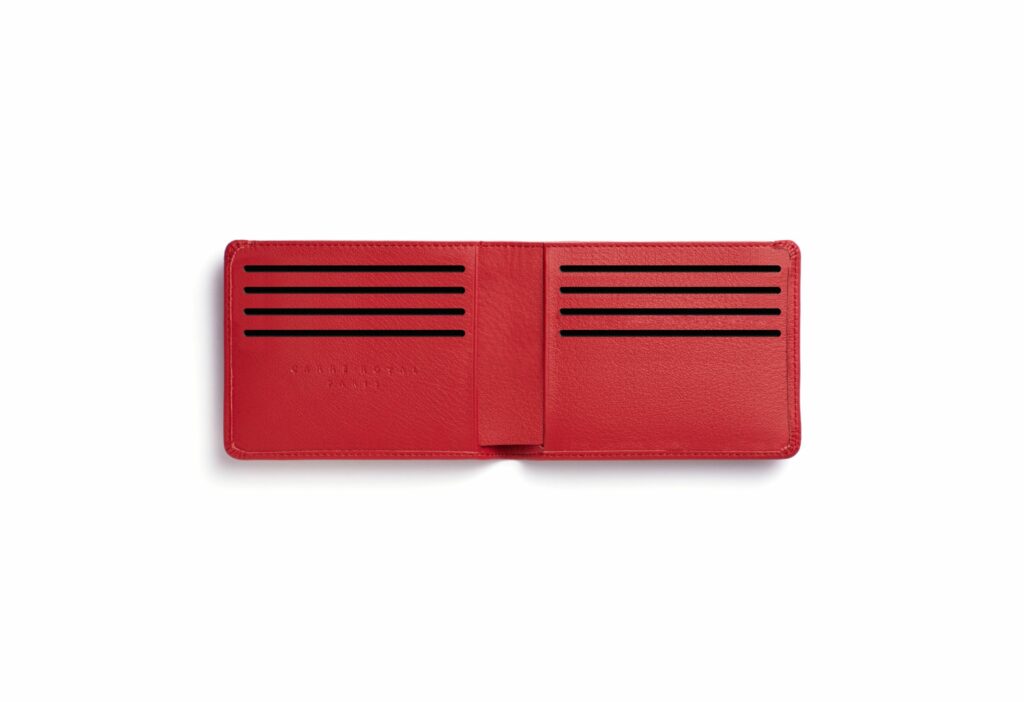
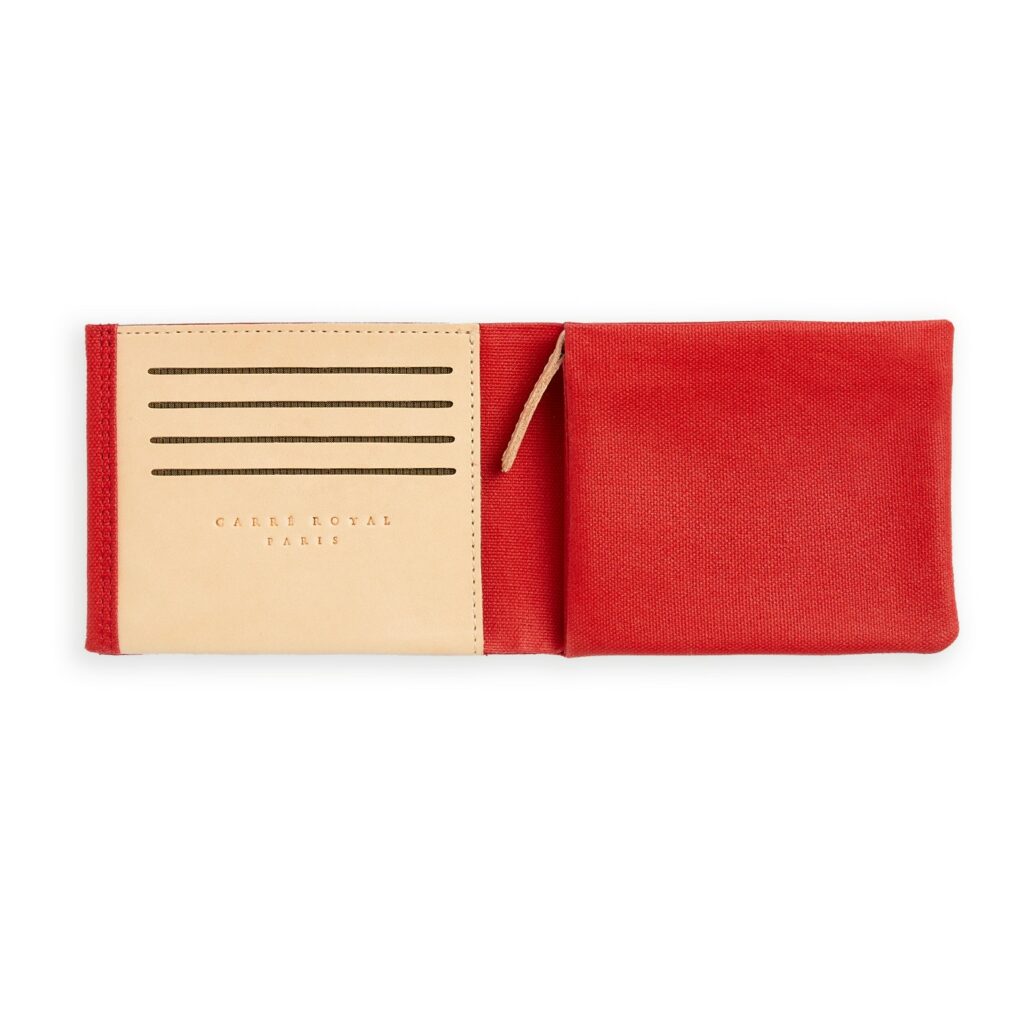
What Calder did to public space, what Kandinsky sought in the vibration of pure colour, Carré Royal transposes to the scale of the everyday object. A red leather wallet is never a mere accessory among others tucked in a pocket: placed on a table, drawn from a bag, it immediately captures the gaze, exactly as Gauguin’s red captures the eye amid an otherwise muted, earthen composition.
The red leather mini bag extends this same intensity, but at the scale of the daily gesture and the moving body. Worn across the shoulder or carried by hand, it does not merely accompany an outfit: it directs it, much as red once directed the gaze toward imperial power, Orthodox sanctity, Chinese festivity, or the Parisian cabaret poster imagined by Toulouse-Lautrec. On the full-grain taurillon leather crafted by Carré Royal, red gains an additional density: the material absorbs and reflects light differently depending on the angle, revealing deep brown nuances in the creases and almost vermilion highlights on the more exposed surfaces.
As with every shade in the Carré Royal palette, red on a wallet or mini bag never remains fixed. It lives alongside its owner, develops a patina at the edges, and deepens over the years in ways the red of the very first day could not yet possess. This is the same logic that animates the entire house palette: every colour becomes tangible through contact with the material, a singular touch that can only be grasped by hand.
To choose a red wallet or mini bag is therefore not to choose a vivid colour among others. It is to choose the colour that, from prehistoric caves to Calder’s stabiles, by way of Gauguin’s Tahitian interiors, Kandinsky’s chromatic theories, and Toulouse-Lautrec’s nocturnal posters, has never once agreed to go unnoticed.
For Men, For Women: How to Wear Red
For men, red should be introduced sparingly but effectively: a red wallet slipped into a dark jacket, raw denim, or a charcoal grey suit adds a touch of character without ever tipping into ostentation. It is a discreet yet confident way to sign an otherwise understated outfit.
For women, the red mini bag becomes a statement piece capable of transforming an entire silhouette. Paired with neutral tones, beige, black, grey, it functions exactly as red does in a soberly decorated interior: a focal point that structures the whole without ever weighing it down.
Caring for a Red Leather Accessory
A red full-grain leather wallet or mini bag requires no complicated care, but a few simple gestures will help preserve its beauty and depth of colour over time. Avoid prolonged exposure to direct sunlight, which can affect the uniformity of the shade. Keep the leather away from excessive moisture, and if it comes into contact with rain, dry it gently with a clean cloth, without rubbing. Never attempt to artificially even out the patina that develops over time: it is precisely what makes each red piece unique, distinct from every other piece to leave the same workshop.
FAQ — The Red Leather Wallet and Mini Bag
Is red an easy colour to wear every day?
Yes, provided its use is measured. A red wallet, discreet by nature since it is rarely on permanent display, is very easy to carry. A red mini bag, being more visible, pairs best with neutral-toned outfits, allowing the colour to express itself fully without creating visual overload.
Does red full-grain leather develop a patina like other colours?
Yes. Like every shade crafted by Carré Royal on full-grain taurillon leather, red evolves with time and use, developing highlights and a depth unique to each piece.
Does red suit both men and women equally well?
Absolutely. Historically associated with power, celebration, or the sacred depending on the culture, red has always crossed gender distinctions. A men’s red wallet adds character to a understated outfit; a women’s red mini bag becomes a true signature piece.
Why does red hold such a distinctive place in art history?
Because it has rarely been used neutrally: from prehistoric cave paintings to Gauguin’s Tahitian canvases, through Kandinsky’s theories, Toulouse-Lautrec’s posters, and Calder’s monumental sculptures, red has always carried a strong intention, sacred, political, sensory, or symbolic.
How should I care for a red leather accessory?
Avoid prolonged exposure to sunlight and moisture, clean gently with a slightly damp cloth if necessary, and allow the natural patina to develop without trying to even it out.
