
There are colours that assert themselves through brilliance. Royal blue, that deep, vivid, almost electric blue, not to be confused with the reserve of navy, belongs unmistakably to the second category. A colour of sovereigns as much as a colour of the sky, it carries within it a history built on rarity, prestige, and visual brilliance. At Carré Royal, every colour in the palette reveals a singular depth through contact with full-grain leather. This piece explores royal blue: its history, its presence in art and interior design, its encounter with taurillon leather, and what it truly means to wear it every day, in a wallet as much as in a mini bag.

A Colour Long Reserved for the Powerful
Contrary to what one might imagine today, blue was not always an easily accessible colour. In antiquity, stable and lasting blue pigments were extremely rare: the only truly reliable source was lapis lazuli, a semi-precious stone extracted almost exclusively from mines in Afghanistan, then ground into a pigment known as ultramarine, literally, the colour that comes “from beyond the sea.” Its cost was so high that it sometimes rivalled that of gold, reserving this shade for only the most prestigious commissions: illuminated manuscripts, the robes of the Virgin in religious painting, or the ceremonial dress of royal courts.
It is precisely this rarity that explains the enduring association between deep blue and monarchical power in France. From the reign of the first Capetian kings, and more particularly under Louis IX, azure blue became the heraldic colour of the French monarchy, associated with the golden fleurs-de-lis on an azure field that adorn the royal coat of arms. This blue was never merely an aesthetic choice among others: it was a declaration of divine and dynastic legitimacy, a colour that distinguished the sovereign from every other holder of land and title. The very expression “royal blue” inherits directly from this history: a colour worn by monarchs, then gradually adopted by the aristocracy and upper bourgeoisie seeking to borrow its prestige.
In the 18th century, the royal porcelain manufactories perpetuated this symbolism through a technical innovation: the Sèvres manufactory, under the patronage of Louis XV, developed an intense, deep blue intended to adorn its most prestigious pieces, a blue that would become a chromatic reference point in French decorative arts in its own right, known as “Sèvres blue.” Applied to the finest porcelain, this shade extends onto a new medium the same logic as the lapis lazuli of medieval illuminators: deep blue as an unmistakable sign of refinement and status.
Royal Blue as Pictorial Statement
In painting, one of the most spectacular examples of deep blue’s use remains that of Giotto, in the frescoes of the Scrovegni Chapel in Padua, completed at the very beginning of the 14th century. Giotto covered the entire ceiling in a deep ultramarine blue, scattered with golden stars, transforming the architectural space into a continuous celestial vault. This choice, at a time when the pigment cost a fortune, reflects a rare ambition: to make blue not merely a decorative element, but the very substance of sacred space, a colour that envelops the visitor rather than simply being viewed from within a painting.
Centuries later, it was Marc Chagall who gave deep blue a near-mystical dimension once again, through his work in stained glass. His creations for religious buildings, notably his stained-glass windows made in the second half of the 20th century, use an intense blue pierced by natural light, creating dreamlike atmospheres in which figures seem to float within a boundless space. In Chagall’s work, blue is never fixed: it changes with the hour of the day, with the angle of the gaze, with the light passing through it, a living colour rather than a mere painted surface.
In the 20th century, one artist pushed the exploration of blue to its very limit: Yves Klein. In 1960, he patented a shade of ultramarine blue of unprecedented intensity and depth, known as International Klein Blue (IKB), which he used to entirely cover canvases, sculptures, and even human bodies during his performances. Klein believed that this colour, stripped of all form and outline, allowed access to a form of immateriality and infinity, blue as space rather than mere shade. This pursuit of an absolute blue, saturated to the point of total abstraction, resonates directly with the intensity inherent to royal blue: a colour that never seeks the middle ground.
Royal Blue in Interior Design and the Decorative Arts
Beyond painting, deep blue has profoundly marked decorative arts around the world. In Northern Europe, from the 17th century onward, the Delft potteries developed a tradition of blue-and-white ceramics that would become emblematic of Dutch bourgeois interiors, a blue softer than royal blue but born of the same quest for a stable, deep pigment, inspired by Chinese porcelain imported by the East India Company.
Further south, in the Islamic world, the ceramics and zellige tilework of North Africa and the Middle East have for centuries developed a spectacular architectural use of deep blue, visible notably in courtyards and façades that structure entire cities around this single colour, creating a chromatic continuity that unifies urban space as a whole. This large-scale use of deep blue, as the visual identity of an entire place rather than as a simple decorative detail, illustrates this colour’s unique capacity to structure space far beyond the isolated object.
Royal Blue in the Object One Carries: Wallet and Mini Bag
What Giotto did to the ceiling of the Scrovegni Chapel, what Klein sought in the total abstraction of pure colour, Carré Royal transposes to the scale of the everyday object. A royal blue leather wallet is never a discreet accessory: placed on a table, drawn from a pocket, it captures the gaze with the same immediate intensity as a Chagall stained-glass window pierced by light, before any conscious analysis of its shape or function even takes place.
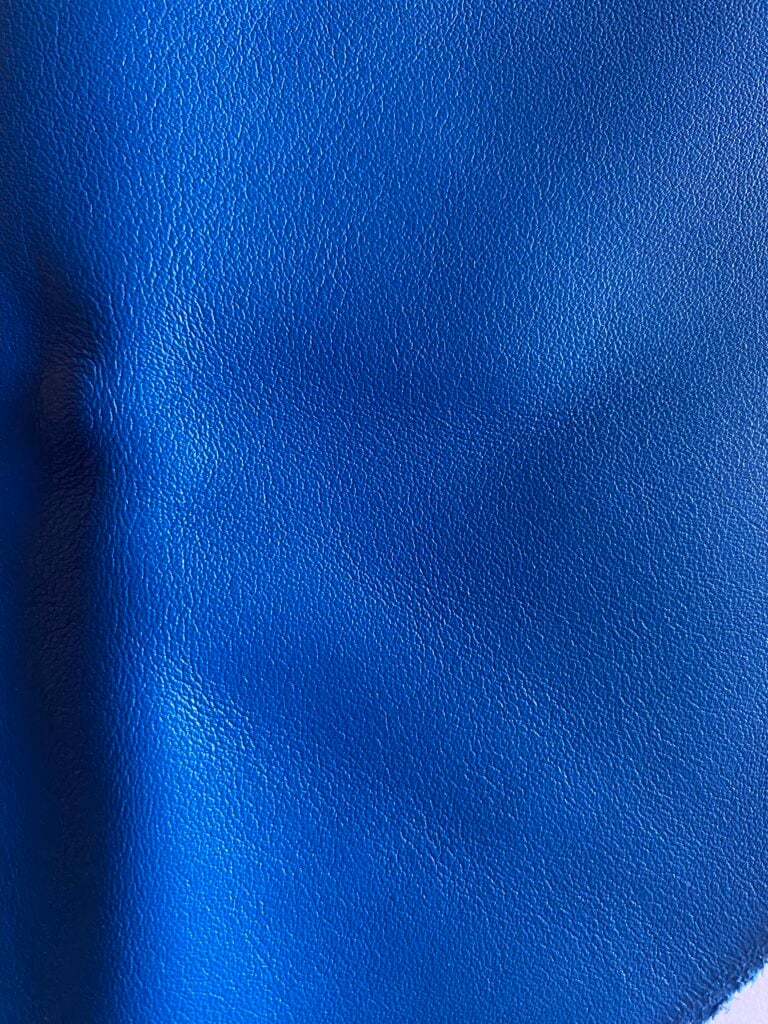
The royal blue leather mini bag extends this same intensity to the scale of the daily gesture. Worn across the shoulder or carried by hand, it does not simply accompany an outfit: it structures it, much as the blue of zellige tilework structures the entire architectural space surrounding it. On the full-grain taurillon leather crafted by Carré Royal, royal blue gains a particular depth: the material captures light and reflects it back with variations ranging from an almost midnight-black blue in shaded areas to almost electric highlights on the most exposed surfaces, a way of bringing to a leather object that same intensity Klein sought in his monochromes.
As with every shade in the Carré Royal palette, royal blue on a wallet or mini bag never remains fixed over time. It evolves with use, develops a patina at the edges, and deepens in ways the colour of the very first day could not yet possess, a reminder that every colour, crafted on full-grain leather, becomes tangible and singular through contact with the hand that carries it.
To choose a royal blue wallet or mini bag is therefore not to choose a vivid colour among others: it is to choose the colour of the Capetian kings as much as that of Giotto’s celestial vaults, the colour of Sèvres blue as much as that of Klein’s absolute abstraction, a shade that has always, across the centuries, marked out what deserves to be noticed.
For Men, For Women: How to Wear Royal Blue
For men, royal blue should be introduced with confident elegance: a royal blue wallet slipped into a grey or beige jacket adds a touch of refined character, a distinctive signature that quietly recalls this shade’s aristocratic heritage without ever tipping into ostentation.
For women, the royal blue mini bag becomes a bold statement piece. Paired with neutral outfits, white, light grey, camel, it acts like the blue of Chagall’s stained-glass windows within an otherwise sober space: a point of intensity that immediately captures light and attention, without ever weighing down the whole.
Caring for a Royal Blue Leather Accessory
A royal blue full-grain leather wallet or mini bag requires no complicated care, but a few simple gestures will help preserve the intensity of its shade. Avoid prolonged exposure to direct sunlight, which can slightly dull the chromatic brilliance over time. Keep the leather away from excessive moisture, and if it comes into contact with rain, dry it gently with a clean cloth, without rubbing. Let the natural patina develop without trying to even it out: it is precisely what distinguishes each royal blue piece from every other piece to leave the same workshop.
The Royal Blue Leather Wallet and Mini Bag
What is the difference between royal blue and navy blue?
Royal blue is a vivid, deep, and luminous shade, historically associated with monarchical power and heraldic azure, whereas navy blue is a darker, more subdued tone, more closely associated with sobriety and maritime tradition.
Why is royal blue associated with the French monarchy?
Since the reign of the Capetian kings, and notably under Louis IX, azure became the heraldic colour of the French monarchy, associated with the golden fleurs-de-lis adorning the royal coat of arms, an origin that gave “royal blue” its name.
Does royal blue full-grain leather develop a patina like other colours in the palette?
Yes. Like every shade crafted by Carré Royal on full-grain taurillon leather, royal blue evolves with time and use, developing deep highlights and a patina unique to each piece.
Does royal blue suit both men and women equally well?
Absolutely. Historically worn by sovereigns and then adopted by the aristocracy as a whole, royal blue has always crossed gender distinctions. A men’s royal blue wallet adds refinement to a sober outfit; a women’s royal blue mini bag becomes a true signature piece.
How should I care for a royal blue leather accessory?
Avoid prolonged exposure to sunlight and moisture, clean gently with a slightly damp cloth if necessary, and allow the natural patina to develop without trying to even it out.
