
This week, I’d like to introduce Basque Pelota (Pelote Basque) and the Chistera. It all started during a conversation with Liza Bergara, ( Makhilas)who told me about this unique skill—something we need to keep the game alive.
It was also a chance to visit a workshop and meet two generations of makers (Pierre and Bixente) in Anglet.
When I was a kid, I used to watch big chistera games during vacation in places like Bayonne, Ascain, or Saint-Jean-de-Luz.
A bit of music to start?
“Oh yeah!” — Laurent Bardainne & Tigre d’Eau Douce
Basque Pelota…
First, I talked with Lilou Etcheverria and René Hardoy (the president and secretary-general of the Basque Pelota Federation). They reminded me of the history of pelota—its different types of games.
Basque pelota comes from jeu de paume (a handball game) that different civilizations played.
You can find paume-style games among the Greeks, Romans, Egyptians, and Aztecs. These games were especially popular in France. Paris once had more than 250 playing halls. Then the trend shifted under Louis XIV. In one of my earlier letters, I mentioned how much King Henry IVloved this game.
The sport is played on a playing area called a cancha. The ball is thrown—especially for the indirect games—against a wall called the frontis.
At the end of the letter, I include match videos that should give you a good idea of it.
Today, Basque pelota is mainly played in the Southwest of France, the north of Spain, and in Basque communities abroad (especially Argentina and the United States).
The players (pélotaris) wear white. Lilou Etcheverria told me that their outfit is a sign of respect for the crowd and for the other players.

…The Chistera Workshop: Chistera Gonzalez…
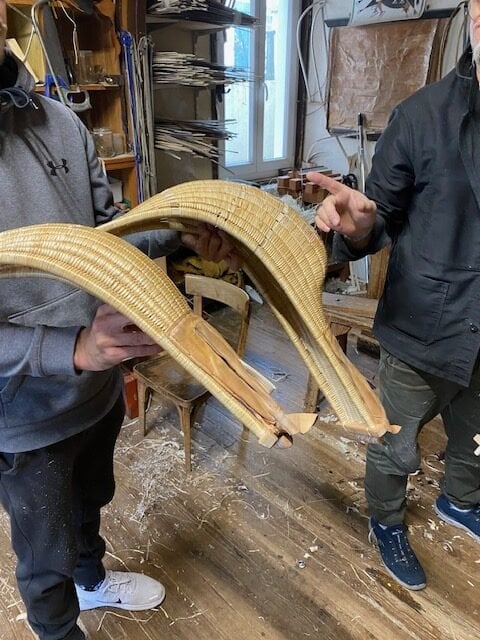
First, chisteras are gloves made mainly from chestnut wood, woven reed (osier/wicker), and leather.
Originally, a chistera was a basket for collecting fruit. The word comes from the Basque term xister, meaning basket. The woven basket is attached to a leather part.
These gloves were invented in 1857 by Jean Dithurbide in Saint-Pée-sur-Nivelle.
There are two types of gloves: the small glove (Joko Gorbi) and the big chistera,” used for Cesta Punta.
The Chistera Gonzalez workshop uses several skills:
– Cabinetmaking/woodcraft (ébénisterie): to build the chistera frame using chestnut rods.
– Wicker weaving (vannerie): to “fill the empty spaces” using reed strips, which are inserted between the chestnut rods.
– **Leatherworking (sellerie):to make the leather part where the player puts their hand. The Gonzalez family uses leather from goats or cattle.
Finally, the chisteras are custom-made based on the player’s hand.

…Talented players…
In this letter, I also wanted to introduce talented players. Cesta punta was long a sport reserved for men. Now women can play, and today there are talented female players—especially Marie and Aude Laugié, and Romane Mercadier from the Pamiers club.
Here are a few videos showing their talent:
– The Basque Pelota Federation website
– The Chistera Gonzalez website
The photos in this letter—on our Instagram and Facebook pages—are taken by me.
To learn more about this letter and its author, I invite you to visit our “Letters” page.
If you liked this letter, please share it widely.

The intelligence of the hand we celebrate in these artisans is at the heart of our work as well-where every details serves structure, balance and longevity.
Discover The Essentials

