
There are colours that follow trends, and there are colours that define them. Black belongs to the second category, a shade that has transcended centuries, cultures, and disciplines to become the enduring signature of refinement. When it meets the dense grain of full-grain calf leather, it reveals something of its essential nature.
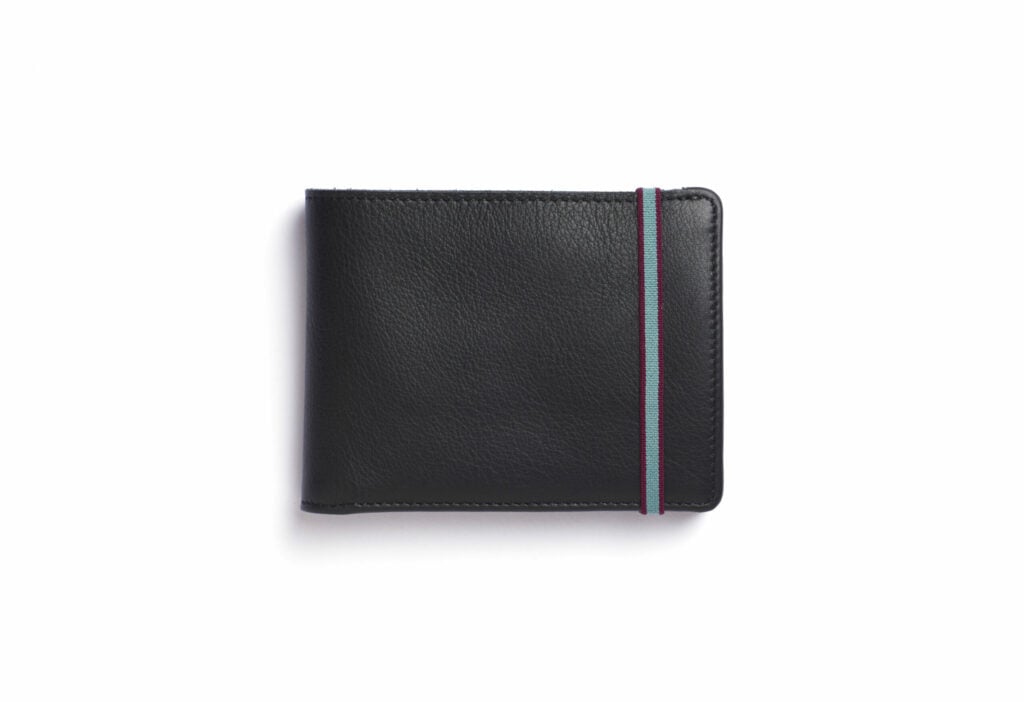
At Carré Royal, the black leather wallet is the meeting point between Parisian savoir-faire, material rigour, and a timeless aesthetic. In this article, we explore black through the prism of leather craftsmanship: its symbolism, its legacy in art and architecture, and what makes a Carré Royal black wallet an object built to last.
Why black remains the most powerful colour in fashion
Black is paradoxical. It is both the absence of colour and the sum of all pigments, an optical mystery that has fascinated artists, philosophers, and designers for millennia. In the world of leather goods, black has always been the benchmark.
Long before it became the choice of fashion, black was the colour of authority. Roman senators wore dark togas to signal gravitas. In the Middle Ages, black dyes were among the most expensive pigments, reserved for royalty, clergy, and the wealthy merchant class. To wear black was to display one’s standing.
The symbolism of black: power, mystery, sophistication
During the Renaissance, Spanish and Flemish courts adopted black as the colour of nobility. Hans Holbein the Younger immortalised this in his portraits of the Tudor court, Henry VIII, Thomas More, Anne of Cleves, where the precise cut of black velvet and black damask against pale skin conveyed power, intelligence, and restraint simultaneously. Black was not mourning; it was mastery.
The twentieth century reinvented it again. Chanel’s little black dress of 1926 transformed black from a colour of mourning into the uniform of modern elegance. Later, the Japanese avant-garde, Yohji Yamamoto, Rei Kawakubo, elevated black to a philosophy: to strip away the superficial and reveal the essential. Their collections of the 1980s, dominated by black, changed the language of fashion permanently. Jil Sander followed the same conviction: black as the ground zero of form, the colour from which everything unnecessary has already been removed.
Black in art: from Caravaggio to Soulages
No colour has inspired artists as profoundly as black. Where other pigments decorate, black structures. It defines form, creates depth, gives gravity to composition.
Caravaggio revolutionised European painting at the turn of the seventeenth century with chiaroscuro, the dramatic interplay between deep shadow and piercing light. His canvases demonstrated that black was not emptiness, but presence.
In 1915, Kazimir Malevich exhibited Black Square at the Last Futurist Exhibition in Petrograd. A black square on a white ground, nothing more. He described it as “the zero degree of painting”: the point from which all forms could be rebuilt. The painting, now held at the Tretyakov Gallery in Moscow, remains one of the most debated works in twentieth-century art. The moment black ceased to be a background and became the subject itself.
Half a century later, Ad Reinhardt brought this logic to its conclusion. His Black Paintings of the 1960s, canvases of deep, seemingly uniform black, now at the Museum of Modern Art in New York — reveal, on sustained looking, subtle cruciform geometries within the surface. He called them “the last paintings anyone can make.” They demand time: the kind of attention that only slow looking affords.
Pierre Soulages devoted his life’s work to the colour, coining the term outrenoir — beyond black, to describe his textured, reflective canvases. For Soulages, black was a source of light, not its absence. His work, held at the Louvre, the Centre Pompidou, and extensively at the Musée Soulages in Rodez, confirmed what leather artisans have always known: black is a colour of infinite nuance, endlessly renewed by texture, grain, and reflection.
In a few weeks, I will visit Rodez, where many of Soulages’ works are exhibited. I will write about black through the lens of his work in the next letter on craftsmanship and noble materials.
Subscribe to the Letters on craftsmanship and noble materials →
Black in architecture
Architecture, like leather craft, is an art of materials and proportions. And in architecture, black holds a singular place.
From the lacquered timber beams of traditional Japanese temples, treated with the ancient shou sugi ban technique, in which charred wood becomes both more resistant and more beautiful, to the black steel and glass of Mies van der Rohe’s Neue Nationalgalerie in Berlin, black signals strength, permanence, and a refusal of ornament.
Peter Zumthor, the Swiss architect whose work at the Therme Vals and the Bruder Klaus chapel has defined a generation of thinking about materiality, treats shadow as an architectural element in its own right. In his hands, darkness is not the absence of light but its most precise instrument, the thing that makes texture legible, that gives surfaces their depth. The same principle governs black taurillon leather: its depth is not flat, but structured, responsive to the light that falls across it.
Walk along the boulevards of Paris and you will find black everywhere: wrought-iron balconies, lacquered doors on Left Bank townhouses, black marble entrances of grand hotels. The black zinc roofs that define the Parisian skyline. Black is woven into the fabric of Parisian architecture, discreet, confident, impossible to ignore.
This is the same language Carré Royal speaks through its leather. A black wallet is, in miniature, a piece of architecture.
Each colour has its own touch
The dyeing process does more than change the colour of the leather. It changes its feel. A yellow wallet and a navy wallet, both made from the same taurillon, will feel different in the hand, one slightly more matte, the other with a finer grain to the touch. Black is no exception. The depth of its dye, and the finishing applied to this particular shade, give it a character that is its own: a density, a slight firmness in the hand that softens with use.
With time, those differences settle. The leather finds its own character.
The language of black leather
Not all black leathers are equal. The difference lies not in the colour itself, but in how that colour lives in the hide.
Taurillon has a particularly dense, tight grain. That density gives it a natural resistance to water and to surface wear, and it is what allows black to remain deep over decades rather than fading at the surface. Full-grain calf leather dyed in depth, as Carré Royal’s is, reveals subtle variations under light: the cool, almost bluish black of a freshly finished hide; the warm depth that develops as the leather ages.
This is the great quality of black leather: it is never static. A black wallet matures over the years, developing a discreet patina, softer at the edges, a gentle sheen where hands have touched it thousands of times, a depth of colour that no new object can imitate.
Carré Royal: the Parisian soul of leather craftsmanship
Founded in Paris in the 1950s, shaped by decades of French leather tradition, Carré Royal embodies a specific idea of what a leather object should be, one rooted not in logos, but in materials, gestures, and time.
I select each hide myself, checking its touch, its grain, its density. These are not abstract qualities; they are felt in the hand, confirmed by years of working with the material. Our black leathers are dyed in depth, not merely on the surface, ensuring that the colour lives in the fibres of the skin itself.
Every stitch, every edge, every corner is finished by hand. The result is a wallet that ages well, which is, I believe, the only honest measure of quality.
This search for beauty in what endures is at the heart of what we do.
The black wallet as a meaningful gift
Few objects carry as much symbolic weight as a finely crafted black leather wallet. Offered for a significant birthday, a graduation, a promotion, or a milestone anniversary, it becomes a marker of time, an object carried daily, every use a quiet reminder of the moment and the person behind the gift.
How to care for a black leather wallet ?
A Carré Royal black wallet requires very little. Once or twice a year, apply a small amount of hand cream, without silicone, without alcohol, across the entire surface, in circular motions. Leave it to absorb for a few minutes, then wipe away any excess with a dry cloth.
Taurillon’s dense grain means waterproofing sprays are unnecessary and counterproductive, they clog the pores rather than protect them. If the wallet gets wet, dry it flat at room temperature, away from any heat source, then apply the cream once dry.
Store it away from prolonged direct sunlight. Everything else, time will take care of.
FAQ
Does a black leather wallet suit every occasion?
Yes. Black is the most versatile colour in leather goods, appropriate for formal, professional, and casual contexts alike.
Does black leather fade over time?
Full-grain black leather dyed in depth retains its depth over decades, developing a refined patina rather than fading.
Is a black wallet a good gift?
Black is universally appreciated, carries a symbolism of seriousness and refinement, and ages well. It is one of the most considered gifts one can give.
How does a Carré Royal black wallet differ from industrial alternatives?
The difference lies in the leather itself, full-grain, dyed in depth, and in the hand-finished details: burnished edges, precise stitching, a finish that cannot be replicated by machines.
A timeless choice, made in the spirit of Paris
A black leather wallet is not a fashion statement. It is a choice that outlasts fashion. It speaks the language of tailors, architects, collectors, and craftsmen.
At Carré Royal, every black wallet is made in this spirit: with hides chosen for their character, with hands that have learned their craft over years, with the conviction that true quality is measured not in logos, but in longevity.
To carry a Carré Royal black wallet is to carry with you a fragment of Paris, its architecture, its art, its refined reserve, and to affirm, without a word, that you belong to those who choose things that last.
