Today we are meeting with a knife-maker artisan, Jean-Paul Tisseyre at La Bastide sur l’Hers, in Ariège Pyrenees. Jean-Paul graduated with the title of “One of the Best Workers in France” in his specialty.
He welcomes me with Newton, his dog.
He manufactures all kinds of knives, most often custom-made, sold all over the world.
His works, his creations are the outcome of a combination of several skills, in particular:
The work of metal that he discovered at the age of 14 and pursued by training as a turner, miller, fitter.
Ariège Pyrenees have a long tradition of metalworking. The Counts of Foix drew part of their fortune and their power from the latter, Ariège indeed provided men and iron.
The work of the horns, more precisely of the horn comb. Jean-Paul Tisseyre belongs to a family of experts in the field. In the 1920s, the local industry employed nearly 1,500 workers, and produced 80% of French production.
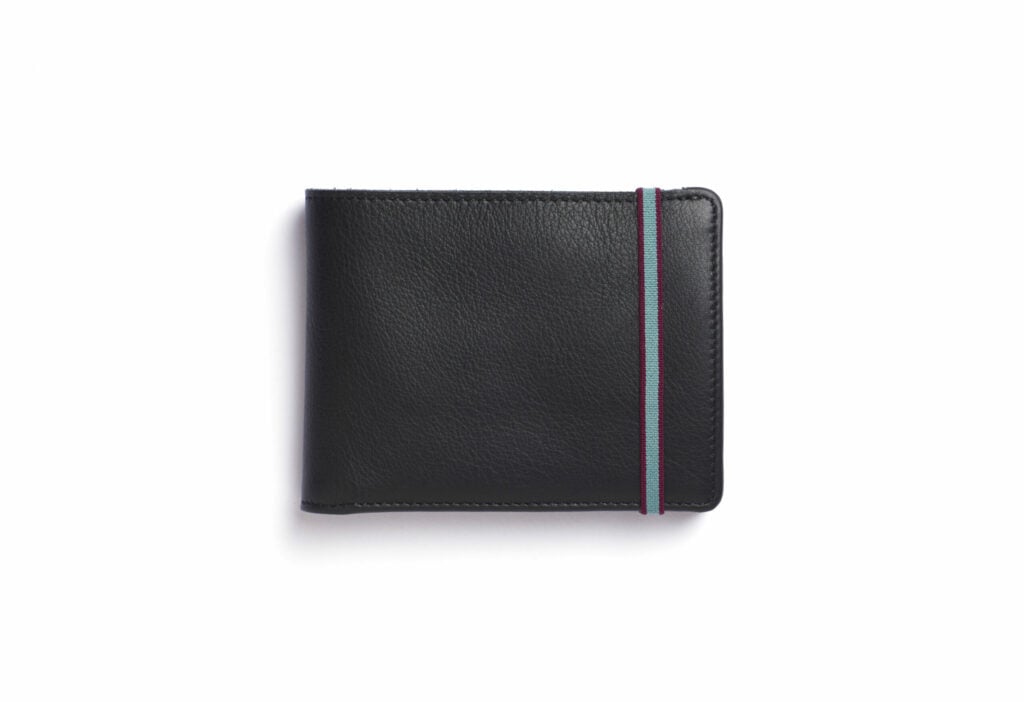
Within Carré Royal, we use different materials, leathers, coated fabrics, fabrics like Harris Tweed… each material is worked differently and reacts in a unique way with others. We often combine leathers and fabrics.
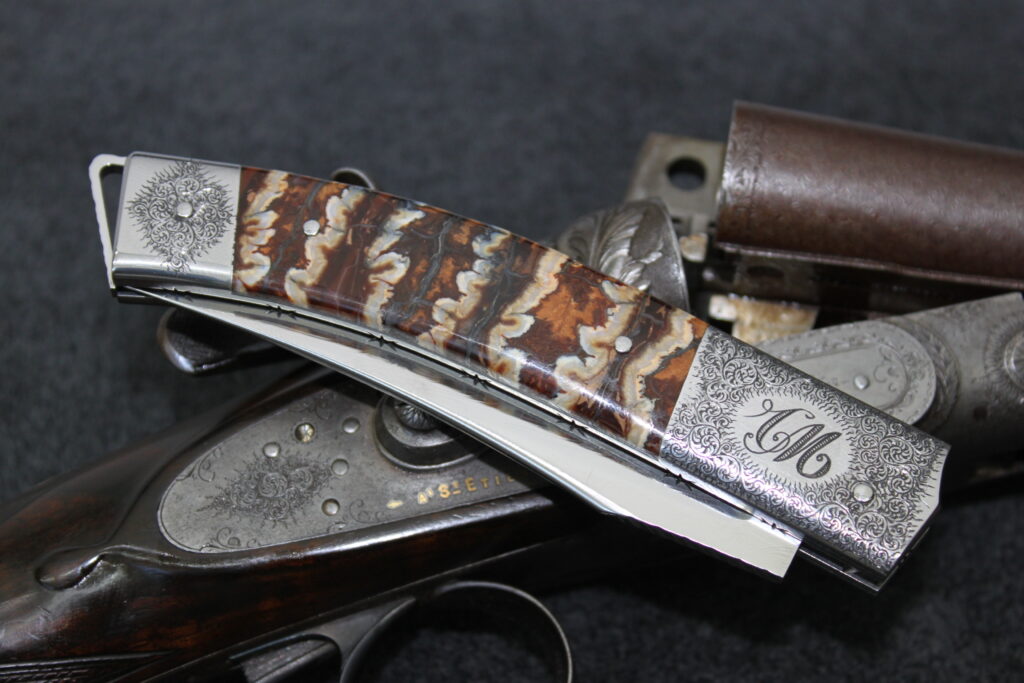
The making of the blade
Everything most often begins with the imagination of a specific line, a blade shape that leads to a template.
Jean-Paul most often works with “damask/laminated” steel.
After this, he begins trimming with a saw, or does so mechanically with a machine, the back stand. This operation consists of cutting according to the template.
Grind: which corresponds to the shaping of the blade to create its cutting edge.
Heat treatments:
Heating: Jean-Paul uses an electric furnace to heat the blade and reach the transformation point of AC3 steel, the quenching temperature.
Quenching: cooling the steel in air for stainless steels, cooling in quenching oil for carbon steels.
The metal transforms, densifies, it is hard but remains very brittle.
Return. This step consists of heating the blade to about 200° for about 30 minutes, to give flexibility and resilience.
Then come the finishing stages, during which the blade is roughened on the back stand and finished with sandpaper by hand. Damascus steel is then revealed by acid attack. This process unveils the pattern of the damascened blade.
The iron sculpture is then completed. The blade only has to be mounted on a handle.
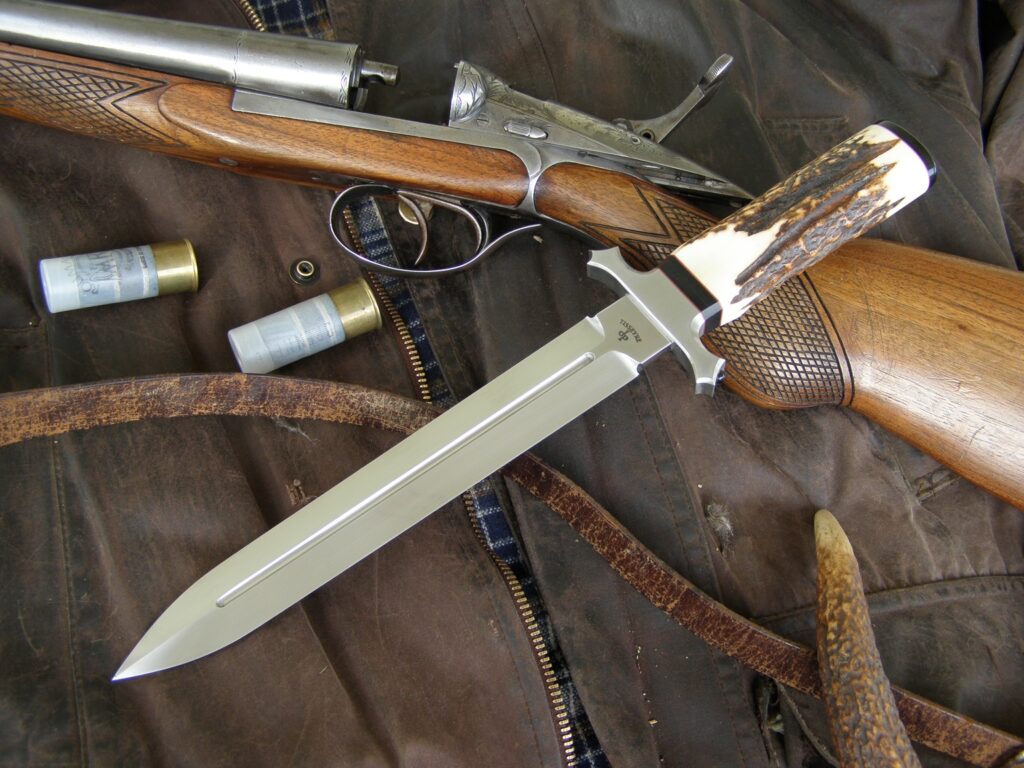
The making of the handle
To make the handles, Jean-Paul uses:
Horns of cows, zebus (the most colorful) from Madagascar, South Africa, Brazil, Argentina and the Pyrenees, buffaloes, or rams.
However, in these horns, Jean-Paul mainly uses the tips, which have the advantage of being naturally resistant. This more expensive method makes it possible to take advantage of the uniqueness of the horn and its colors. He shows me how to identify the final colors, their combinations in the finished product.
Antlers (deer, roe deer, etc.)
The woods of the surrounding mountains: Jean-Paul uses pieces of boxwood, chestnut trees, poplar, oak. He is mainly interested in roots and growths. He finds unique color combinations, original sensuosities.
He finally uses carbon fibers for more modern knives.
These materials are then shaped, sculpted to obtain the desired shape, after which they are polished, and waxed.
Depending on the creations, Jean-Paul imagines a blade then creates a handle, or vice versa. These are the horns, antlers, which he finds, and sometimes they extend into a blade.
We then talk about the transmission of this know-how.
Times flies by, the encounter is fascinating.
I leave Jean-Paul and Newton.
The photographs in this letter and on our Instagram and Facebook pages are from https://www.couteaux-tisseyre.com.
To learn more about this letter and its author, please visit our Introductions to Carré Royal Letters page.
If you enjoyed this letter, please share it.
My letters are now available on Carré Royal Letters.
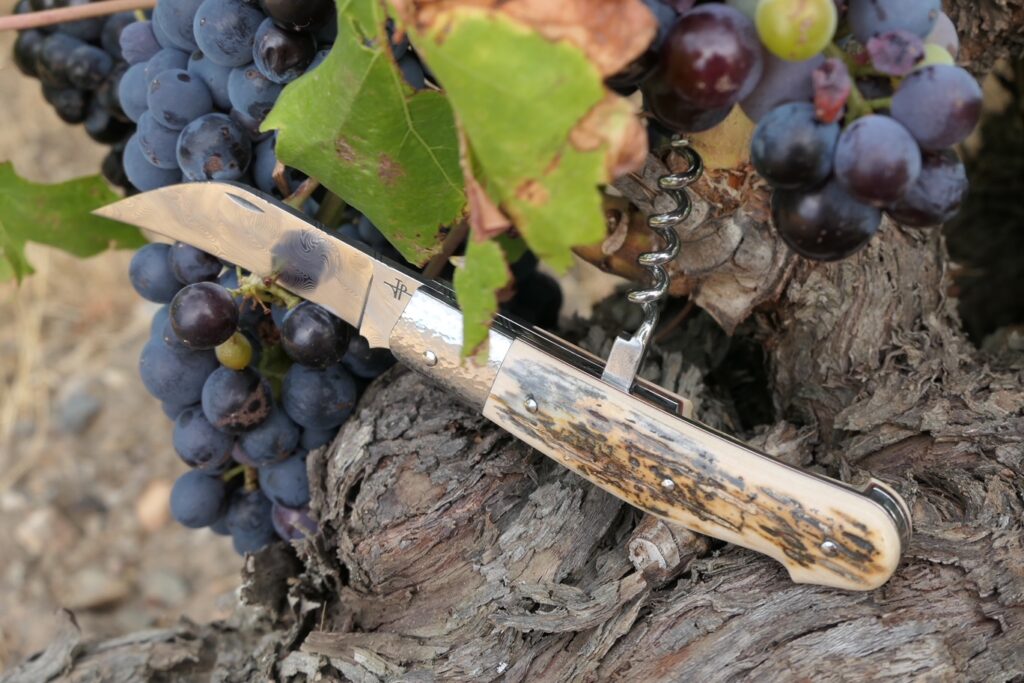
Montsegur & Fontestorbes
The village of La Bastide sur l’Hers is located near some rather exceptional places:
The Château de Montségur, a Mecca of Catharism.
I sometimes stop at the traditional bakery on the square.
Belesta forest,
Fontestorbes Fountain.
Some music:
L’hymne des Pyrénées
Eric Satié Gnossienne I Lent – Klára Körmendi
Eric Satié – Gnossiennes : III. Lent- Frank Glazer
Reading suggestion
Les Plaies et les bosses by René-Victor Pilhes, interviews with Maurice Chavardès,
« Illegitimate child, René-Victor Pilhes had a revelation at 13 of this society which tells you: “I don’t know who you are, therefore I don’t know you. Why would I recognize you if your own father denies your existence, refuses you, his own name?” An injustice which is undoubtedly at the origin of his vocation as a writer: before being named, the father of the turbulent kid was first a dream father, the horizon of an unknown and fantastic universe… »
The intelligence of the hand we celebrate in these artisans is at the heart of our work as well-where every details serves structure, balance and longevity.
Discover The Essentials