
Today, I’d like to invite you to join me on a walk—not in the Pyrenees, but in Paris, between Place des Vosges and Place de la Concorde. It’s a chance to discover the splendor of the Paris I love.
Here, you can experience exceptional architectural ensembles that leave a lasting impression. I see the essential beauty—the right kind of beauty—in architectures that keep moving us, astonishing us, across the centuries.
It also reminds me how important beauty and aesthetics are in our lives—especially in cities.
The beauty of nature in the Pyrenees or in Brittany, the beauty of these Paris monuments, and the search for beauty through Carré Royal all help give meaning to my existence.
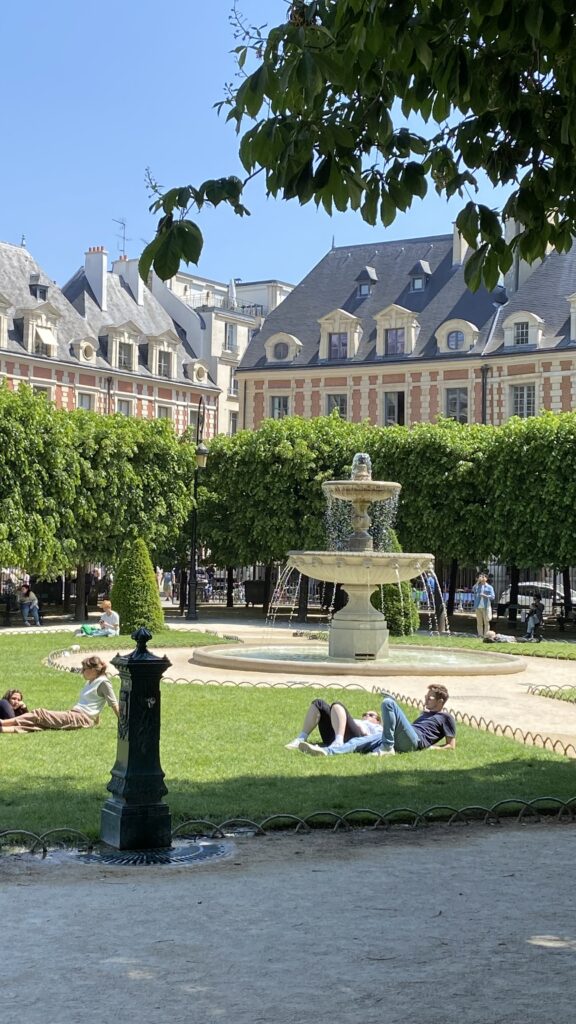
Place Royale (today, Place des Vosges)
After the Wars of Religion, Henry IV restarted the development of the Marais—especially with the building of Place Royale.
The project, supported by the King in 1604, originally began as a commercial place, and its construction was overseen by the Duke of Sully.
The square was built between 1605 and 1612. It’s a great example of civil architecture, with dimensions that are almost square (140 m x 127 m?), inspired by the southern style of the Southwest, the region the monarch was so attached to.
The bourgeois pavilions were quickly transformed into aristocratic residences, known for their polychrome stone façades (pale stone) and red bricks. Very soon, it became a place where Parisians would stroll—and a meeting point for the aristocracy under Louis XIII.
When the court moved to Versailles, the Marais was neglected.
The square has been gradually renovated since 1966 to bring back its beauty, thanks in particular to the Malraux Law (1962).
The emphasis placed on culture and on preserving this architectural beauty makes me think of Marguerite Yourcenar’s words:
“ You do not destroy the Beauty of the world without destroying the health of the world, and even the balance of the world.”

The Louvre’s Cour Carrée
The Cour Carrée is part of Henry IV’s “Grand Design.” You can see it in an early plan for completing the Louvre, dated 1595.
The courtyard was truly finished during the reign of his grandson, Louis XIV.
The different buildings that make it up form a square of roughly 160 meters per side.
Sometimes, I get the feeling it’s a mysterious, almost magical place.
I feel like I’m in an ancient temple—where you experience a beauty that elevates you, through regularity, balance, and harmony.

The King’s Great Storage for the Crown (today, the Hôtel de la Marine)
This is a magnificent place where the royal furniture and the crown jewels… would be kept.
It quickly became the place for orders, and for storing luxurious, refined creations. Starting in 1777, the Garde-Meuble opened to host the first Decorative Arts exhibitions.

Henry IV, the City Planner King
His reign was marked by the construction of many architectural projects.
The King followed the example of his grandfather, Henry II of Navarre, and his mother Jeanne, who equipped the city of Pau to improve public health and sanitation. Henry IV was first interested in city roads and the water supply of the capital.
He wanted to make Paris more beautiful.
He was especially passionate about architecture and often used the phrase “My Buildings.”
“Some blame me,” he wrote to Sully in 1607, “for loving buildings and rich works too much; others blame me for hunting…”
And when he won at Jeu de Paume (1), he also said: “It’s for my masons.”
In Paris, he had several places built: Place Royale, Place Dauphine, and also the Saint Louis Hospital. He built the Grande Galerie, linking the Louvre to the Tuileries over roughly 500 meters.
Many projects (including Place de France in today’s 3rd arrondissement) were abandoned after his assassination in 1610.
My readings for this letter
– A book about the Foix-Béarn: Henry III of Navarre, who became Henry IV of France—because he was indeed the last Count of Foix.
– The Counts of Foix: From the Pyrenees to the French Throne, 11th–16th centuries, by Claudine Pailhès.
“Until now, the history of the Foix Counts’ dynasty had never been written. Yet we are dealing with an extraordinary lineage—one whose unbroken path led from the mountains of Upper Ariège to the French throne…”
– Henry IV, by Jean Pierre Babelon — source of the quotes (1).
One of my favorite places in the Marais
Hôtel de Sully https://www.hotel-de-sully.fr

A little music
– Praetorius…
– “She,” by Charles Aznavour
– “Because the Night”
My favorite lunch spots
– Hôtel Amour, 8 rue Navarin, 75009
– Soya, 20 Rue de la Pierre Levée, 75011 Paris
